Calm Down Corner Ideas for Home: How We Set Up a Quiet Spot for Our Autistic Son
This post contains affiliate links. If you buy through them, I may earn a small commission at no extra cost to you. As an Amazon Associate I earn from qualifying purchases. I only recommend things I truly believe in. Read my full disclosure.
I’m a mom, not a doctor, OT or BCBA. This is what works in our house, not advice for your child. If something here doesn’t fit your kiddo, trust yourself and the people who know them.
Our calm down corner started as a pile of couch cushions and a blanket I threw over two dining chairs. That was it. No Pinterest board, no matching bins.
It worked better than anything I’ve bought since.
If you’ve been searching calm down corner ideas at home because the holidays are coming and your house is about to get loud, hi. Me too. Here’s what’s in ours now, what I’d skip, and the one rule that keeps it from turning into a punishment.
Why we have a calm down corner at all
Christopher is seven. When the world gets too loud or too bright or too much, he needs somewhere to go that isn’t the middle of it. For a long time I thought my job was to fix the moment. Talk him through it. Hold him. Distract him.
Sometimes that helps. A lot of the time, what he actually needed was less. Less talking, less light, fewer people looking at him.
So the corner isn’t about calming him down on my schedule. It’s a place he can go when his body says “enough,” and come back out when he’s ready.
It’s the same idea as the quiet spot I set up before every holiday visit, which I wrote about in Thanksgiving with an Autistic Child. The home version just gets to be a little cozier.
The one rule: it’s never time-out
This is the part I’d tell a friend first.
If the calm corner is where kids get sent when they’re in trouble, it becomes the trouble spot. Then nobody wants to go there, including the kid who really needs it.
So at our house:
- He’s never sent there as a consequence.
- He can go any time, no asking.
- Nobody follows him in to talk about what happened. (That conversation, if it happens at all, is later.)
- It’s his. Visiting kids can look, but the corner is his first.
Teachers, I know a classroom calm corner works a little differently with twenty-two kids and one beanbag. The “not a punishment” part still matters, maybe even more.
Calm down corner ideas: what’s actually in ours
Short list. I’d rather have five things he uses than twenty he ignores.
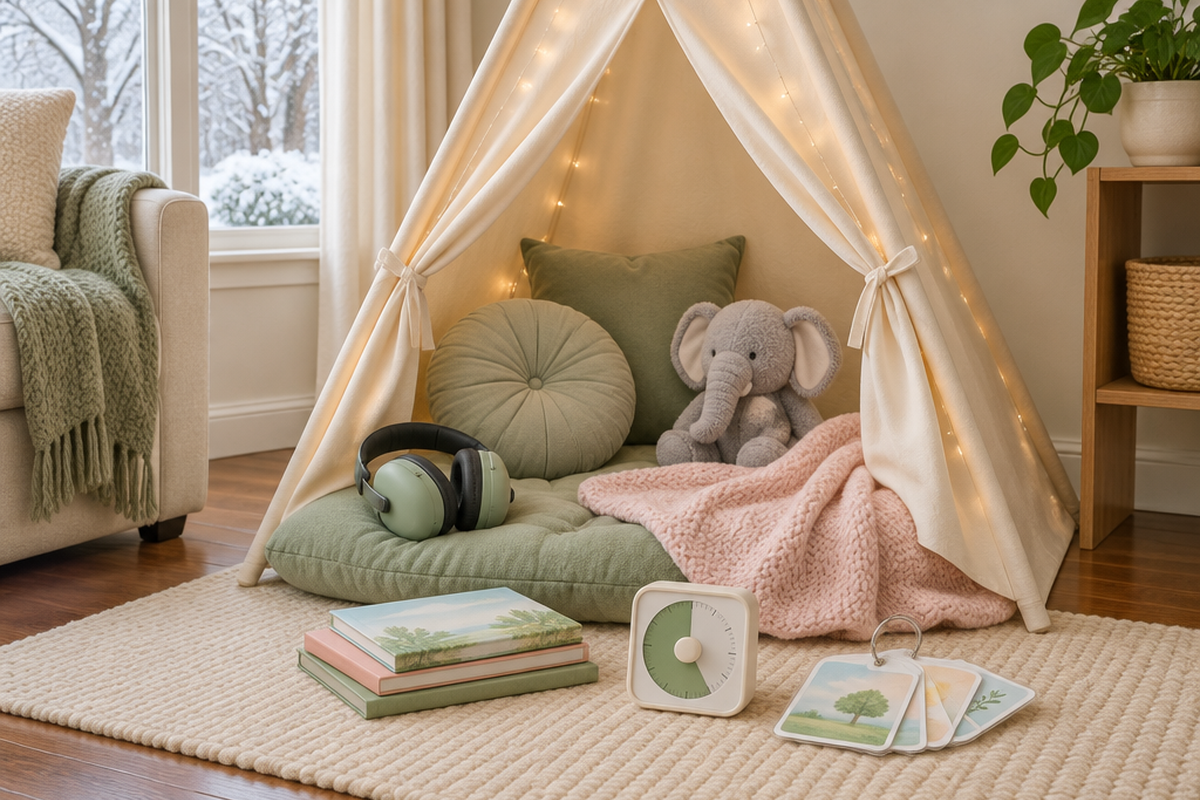
1. Something that makes it feel enclosed
A small tent, a fort, a blanket over chairs, the space behind the couch. Kids who are overwhelmed often want walls. A kids’ play tent like this Little Dove one is the easy version (it says ages 3 and up). Before we had a tent, the blanket over two chairs did the same job for free.
2. Something to make it quieter
Kids’ noise-reducing earmuffs live in the corner, and a second pair lives in the car. They’re the same ones I mention in our Thanksgiving post. When the house is full of people, the corner plus earmuffs is about as quiet as it gets.
3. Soft light, not bright light
We turn the big light off and use battery fairy lights instead. If your set has a twinkle or flash mode, skip it. Steady only. Blinking lights are the opposite of calm in our house.
4. Something soft to sit on, and one comfort thing
A floor cushion, a beanbag, or honestly the couch cushions you already own. Plus one comfort thing that is always there.
5. A way to see time
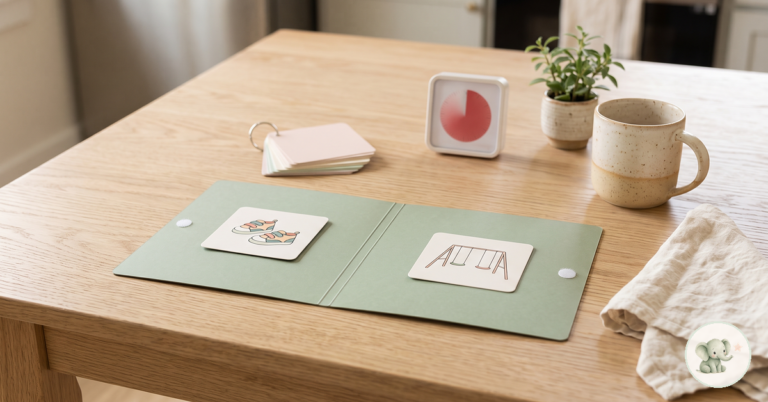
Not for rushing him. For the times we do have to leave, like when the car is packed. A Time Timer visual timer shows the red part shrinking, which is a lot easier for him than me saying “five more minutes” for the fourth time. It’s the same timer from our bedtime routine post.
6. Pictures instead of a speech
When he’s upset, words are the hardest thing to get in or out. So the corner has a few picture cards on a ring: “I need a break,” “too loud,” “hug,” “alone,” “water.” He can point instead of explain.
Ours are from the Feelings & Calm-Down Cards in my shop, but you can draw your own on index cards. Stick figures count. If you want to try picture cards first, the free Routine Cards Starter Set on the same page has a First/Then board you can use in the corner too.
7. A book or two about feelings (for later, not mid-meltdown)
We read these when everybody is calm, so the words are already familiar when things get hard. The Color Monster sorts feelings by color, which is an easy way in for little kids. The Way I Feel is simple and has one feeling per page.
What I skipped (and why)
- Anything with a lot of buttons, sounds or music. Sensory toys that light up and sing feel calming in the store. In the corner, they turned into one more thing to get worked up about.
- A wall of feelings posters. Too much to look at. Two or three cards on a ring is plenty.
- “Calm down” rules written on a sign. He didn’t need instructions. He needed a place.
- Spending a lot up front. Start with the blanket fort. Add things only after you see what your kid actually uses.
How we introduced it
We didn’t introduce it in the middle of a meltdown. We built it together on a calm afternoon. He picked where the lights went.
Then I used it myself, out loud. “I’m feeling grumpy. I’m going to sit in the cozy spot for a minute.” Kids copy what we do way more than what we say.
For the first couple of weeks we visited it when everything was fine. Read a book in there. Had a snack in there. So when a hard moment came, it was already a good place, not a strange new one.
Taking the calm corner on the road for the holidays
Holiday visits are where we need it most and have it least. So we pack a mini version:
- earmuffs
- a tablet with downloaded shows (no Wi-Fi password hunting)
- the card ring
- one comfort thing
When we get there, I find a spare bedroom or a quiet porch and show him: “This is your quiet spot.” He doesn’t have to ask to go. If you’re making a picture schedule for the day, add the quiet spot as one of the pictures. Our visual schedule post shows how we make ours.
For teachers, SLPs and BCBAs
If a family tells you their child has a calm spot at home, ask what’s in it. Matching even one or two things at school (the same earmuffs, the same “I need a break” card) can make the classroom corner feel familiar faster. And if you’re sending something home before winter break, a printed “I need a break” card is a small gift parents will actually use.
Quick FAQ
What should be in a calm down corner? Something cozy and enclosed, a way to make it quieter, soft light, a comfort item, and a way to ask for what you need without words. Start small.
Is a calm down corner the same as time-out? Not in our house. Time-out is a consequence. The calm corner is a choice he gets to make, any time.
Do you need a whole room? No. Ours started as a blanket over two chairs. A closet floor, the end of a hallway or a corner of the bedroom all work.
What age is it for? We started when Christopher was little, and he still uses it at seven. Grown-ups need one too, honestly.
What’s in your kid’s calm spot? I’m always looking for ideas, especially the free ones.
More from us: Thanksgiving with an Autistic Child · Visual Schedule for Autism · Bedtime Routine for an Autistic Child · Printables shop · Our story