A Christmas Social Story for Autism: Santa, Presents and a House Full of People
The first year we put up the tree all in one afternoon, Christopher would not walk into the living room.
I didn’t get it at first. It was pretty! It was festive! But from his side, the room he knew had changed overnight. A giant new thing in the corner, blinking. Of course he didn’t want to go in there.
So now we do Christmas slowly, and we tell him about it first. Here’s how.
We decorate in pieces
The tree goes up first, no lights, and it stays like that for a day or two. Then lights, on steady, not blinking. (We have never once used the blinking setting since that year.) Ornaments come last, and he helps hang the unbreakable ones.
If you’re searching “sensory friendly Christmas tree,” that’s really all it is. Steady lights, fewer things, and changes in small steps.
The story
I write Christopher a little Christmas story in late November, the same way I did for Thanksgiving. One sentence a page, a stick-figure drawing on each. We read it a few times a week until Christmas.
Here’s roughly what ours says. Change anything that doesn’t fit your family:
In December, our house looks different. We put up a tree with lights. The tree is for looking. I can touch the soft ornaments. We might see Santa. Santa might say “ho ho ho.” That can be loud. I can wave to Santa. I don’t have to sit on his lap. On Christmas, there might be presents. I can open one, then take a break. People might come to our house. If it is too loud, I can go to my quiet spot. After Christmas, our house will look like normal again.
That last page matters more than any of the others. He wants to know it ends.
Santa, without the line
Long lines and a stranger in a big beard is a lot to ask of any kid. A few things that helped us:
- Look for “sensory friendly Santa” events. Many malls and stores do quiet hours before opening. You’ll have to search for ones near you.
- Waving counts. A high five counts. A photo from across the room counts.
- Skip it entirely if it’s not his thing. Santa doesn’t need a photo to exist.
Presents, one at a time
We open one present, play with it for a bit, and then open another. It stretches the morning out and nobody melts down over the pile. Some years we’ve opened a few on Christmas Eve too.
If unwrapping itself is hard (the noise, the surprise), try gift bags, or wrap in clear cellophane so there’s no mystery.
Visitors
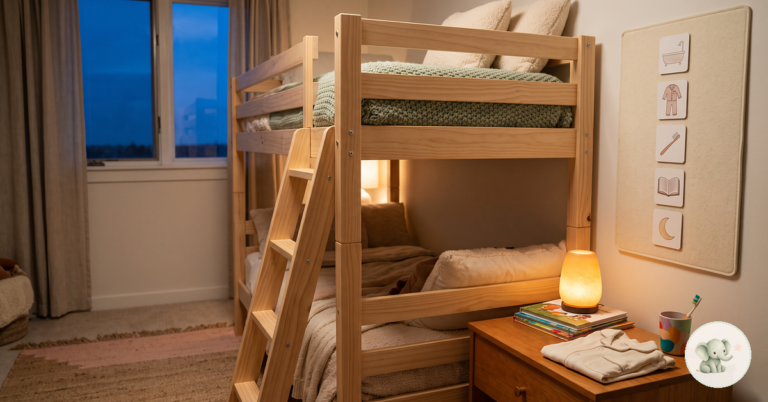
Before family arrives, we look at photos of who’s coming. That’s it. A picture of Aunt so-and-so on my phone, “she’s coming on Christmas.” No surprises at the door.
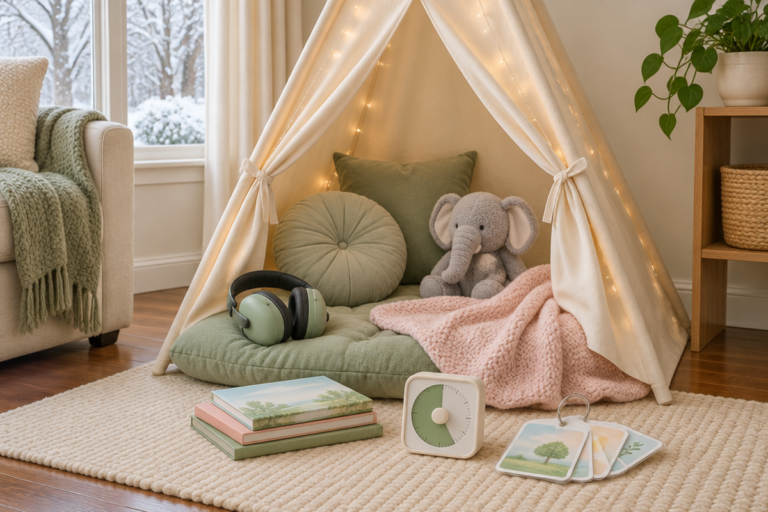
And the quiet spot from Thanksgiving comes back. Same earmuffs, same blanket.
Make your own in ten minutes
You don’t need a template. Plain paper, a pen, one sentence per page. Use “might” instead of “will.” Put a happy, normal ending on the last page. If you want pictures, our Going Places Visual Cards in the shop have a few that fit (car, house, say hi), or draw them. Stick figures are completely fine. Christopher likes mine better than the printed ones, which I choose to take as a compliment.
For teachers, SLPs and BCBAs: if you make a classroom version, keep the family parts open. Not every kid does Santa, and not every kid has people visiting.
What’s the part of Christmas that’s hardest at your house? Mine is the week after, honestly. More on that next week.