Bedtime Routine for an Autistic Child: The Picture-Card Wind-Down That Works for Us
This post contains affiliate links. If you buy through them, I may earn a small commission at no extra cost to you. As an Amazon Associate I earn from qualifying purchases. I only recommend things I truly believe in. Read my full disclosure.
I’m a mom, not a doctor, therapist or sleep specialist. This is what has worked in our home, shared from one parent to another. It isn’t medical advice. If sleep is a real struggle in your house, please talk with your child’s pediatrician. They’re the right person to help you figure out what’s going on.
Hi friend. If bedtime at your house feels like the longest hour of the day, I see you.
For a long time, ours was a nightly negotiation. One more show. One more drink of water. Then a meltdown at the bathroom sink because the toothpaste was “wrong” tonight. By the time Christopher was finally in bed, I was too worn out to enjoy him at all.
What changed things for us wasn’t a magic product. It was a bedtime routine for an autistic child that he could actually see. Same steps. Same order. Pictures he could touch and move. Bedtime stopped being a surprise, and once it stopped being a surprise, it got so much calmer.
Christopher is 7 now. Here’s exactly how our wind-down works, what we use, and what I’d tell any parent starting from scratch.
Why a Visual Bedtime Routine Helps So Much
For a lot of autistic kids, the hard part of bedtime isn’t sleep. It’s the transitions. Bedtime is really six or seven small transitions stacked on top of each other: stop playing, go upstairs, get in the bath, get out of the bath, get dressed, brush teeth, get in bed. Each one is a chance for things to fall apart.
When I just said the steps, the words disappeared into the air. When the steps were on a board in front of him, they stayed put. He could check what was next without me repeating myself for the fifth time, and he could see the end coming.
That’s the whole idea. A visual bedtime routine takes the “what happens next?” worry off his plate, and it takes the nagging off mine.
If you’re new to visual schedules in general, my post on how we use a visual schedule for autism at home is a good place to start. This post is the bedtime chapter.
Our Bedtime Routine, Step by Step
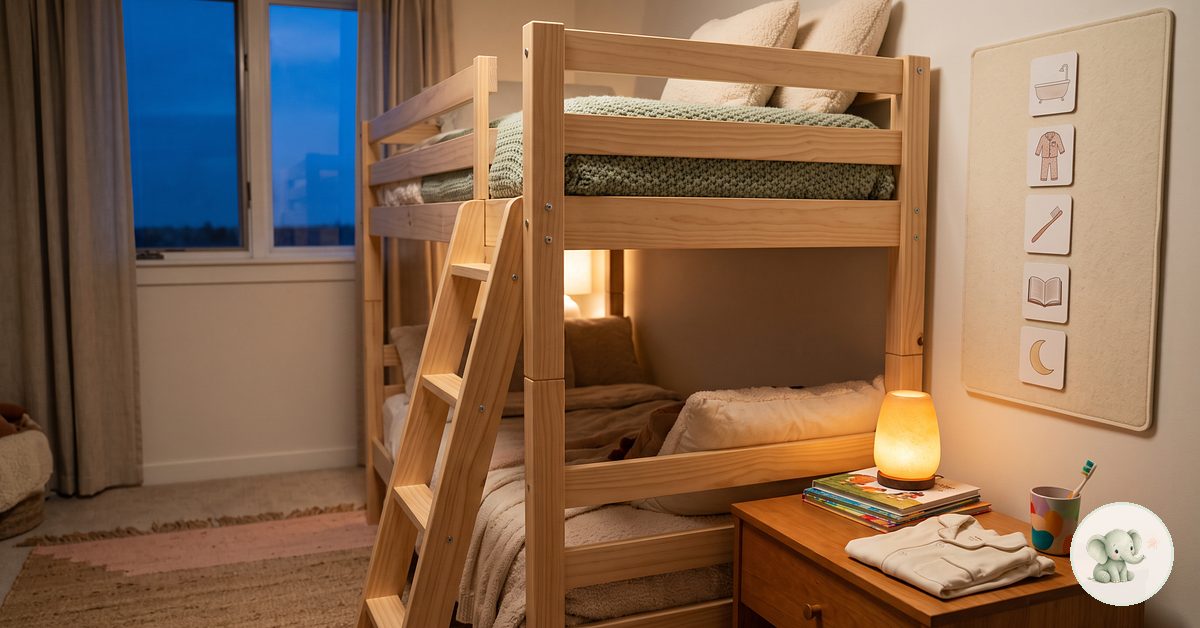
Here is our actual wind-down, in order. It lives on a board on the wall right where he can see it.
- Screens off. This is first on purpose. It’s the hardest step, so it gets a picture card and a timer (more on that below).
- Bath time. Warm, short and predictable.
- Pajamas on.
- Brush teeth.
- Story time. Up in his top bunk, which is his favorite cozy spot in the whole house.
- Bedtime prayer.
- Lights out.
That’s it. Seven steps. Most nights we follow it exactly, and when we can’t (late nights, sick days, travel) we keep the order even if we skip a step. The order is what his body has learned.
To this day, Brush Teeth is the card Chris fights me on. What kid doesn’t? But he can see Story Time sitting right after it, and that gets him to the sink a lot faster than me asking for the fourth time.
How to Make a Bedtime Visual Schedule
You don’t need anything fancy. Here’s how I’d set one up this week.
1. Pick 5 to 8 steps
Fewer is better when you’re starting out. Write down what already happens most nights, in the order it happens. Don’t add new steps yet. You’re making the routine visible, not reinventing it.
2. Use one picture per step
Each step gets its own card with a simple picture. Real photos of your own bathroom and toothbrush work great for some kids. Others do better with simple drawings. Christopher likes the drawn cards because they look the same every night.
3. Put it where bedtime happens
Ours is near his room, at his eye level. Not on the fridge downstairs where nobody will look at it at 8 p.m.
4. Make the cards movable
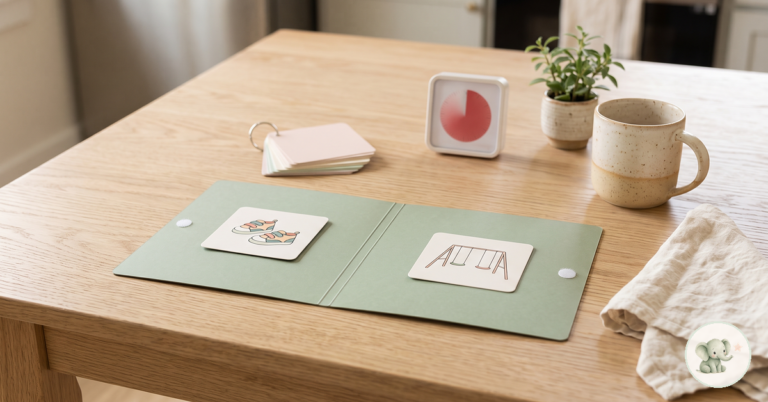
This is the part that made it click for us. Each card has a VELCRO Brand sticky back dot on the back so it can come off the board. When a step is done, he moves the card to the “All Done” pocket. That little physical action of finishing something is so satisfying for him. Laminate the cards first if you can, so they survive toothpaste fingers.
5. Practice when everyone is calm
Walk through the board together once or twice during the day, just for fun. Point to each picture. Act it out a little. Then the first real night, it already feels familiar.
The Printable We Use
I made our Visual Daily Routine Cards because I wanted bedtime cards that were simple, calm and not covered in cartoon chaos.
The set has a bedtime board with 8 numbered steps and an “All Done” pocket, plus 12 bedtime cards like Bath Time, Pajamas On, Brush Teeth, Story Time and Bedtime Prayer. There’s a matching morning board too, a blank board for building your own routine, a First/Then board and a 5-star token board. It also comes with 12 blank cards so you can add the things that are special to your family.
If you’d like to try the idea before buying anything, there’s a free Routine Cards Starter Set in the shop.
Little Things That Made Our Wind-Down Easier
None of these are required. They’re just the things that earned a permanent spot in our routine.
A visual timer for “screens off”
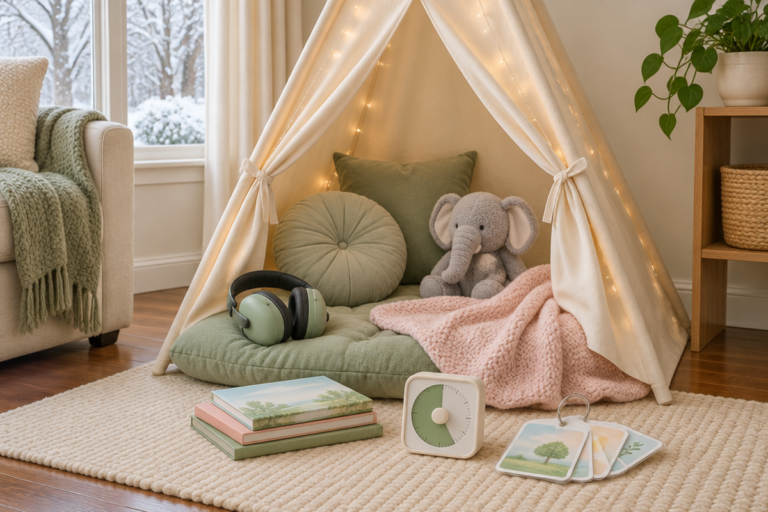
The jump from screens to bath was our hardest moment every single night. A Time Timer visual timer shows the time left as a red section that shrinks, so “ten more minutes” is something he can watch instead of something I keep announcing. When the red is gone, the screen goes off. No arguing with me. The timer said so.
A sound machine and night light on a schedule
We like a soft, steady sound at night and a gentle light that isn’t bright white. The Hatch Baby sound machine and night light can be set to come on with the same sound and light at the same time every night, which fits right into a predictable routine. The name says “baby,” but plenty of families keep using these as their kids get bigger.
Amber night lights in the hallway
If your kiddo gets up at night, a dim path to the bathroom helps. We use GE SleepLite amber night lights, which turn on by themselves when it gets dark. The warm amber glow feels a lot gentler than a bright hallway light.
Blackout curtains
Summer bedtimes are hard when the sun is still up. NICETOWN blackout curtains made his room feel like nighttime even in July. Bonus: they also help on dark winter mornings when you want everyone to sleep in a little.
A note on weighted blankets and sleep aids: I’m not linking any of those here on purpose. If you’re wondering about them, that’s a great question for your child’s pediatrician or OT, who knows your child.
What to Do When the Routine Falls Apart
Because it will. Some nights it just does.
Keep the order, shrink the steps. On a rough night, we might skip the bath and do a quick washcloth instead. But it still comes before pajamas, and the card still gets moved. The pattern stays even when the details change.
Use First/Then for the sticky step. If brushing teeth is the battle, “First teeth, then story” on a First/Then board makes the reward visible. It works better for us than bribes said out loud.
Prepare for changes ahead of time. If a babysitter is doing bedtime, or we’re sleeping somewhere new, I take the board with us. Same cards, same order, new place. That one habit has saved more than one holiday visit.
Lower your voice, not your expectations. When he’s dysregulated, more words make it worse. I point to the next card and wait. Quiet and boring wins.
Our hardest nights usually come at the end of a big, busy day, when he’s running on empty and honestly, so am I. What helps is the boring version. I stop talking, we skip whatever we can skip, and I just keep pointing to the next card. We get to lights out late, but we get there in the same order.
How Our Bedtime Routine Changed as He Grew
When Christopher was little, bedtime was all me. I moved the cards, I ran the bath, I picked the book.
Now that he’s 7 and speaks in full sentences, he runs a lot of it himself. He moves his own cards. He picks his own story. Some nights he reads to himself up in his top bunk for a while before lights out, which is honestly one of my favorite things in the world.
The board is still on the wall. He just needs it less. That’s the goal of every visual routine in our house: support now, independence later.
Quick Answers
What is a good bedtime routine for an autistic child? A short, predictable set of steps in the same order every night, shown with pictures. Five to eight steps is plenty. Ours is screens off, bath, pajamas, teeth, story, prayer, lights out.
How long should a bedtime routine take? Ours takes about 30 to 45 minutes from screens off to lights out. Pick a length you can actually do on a tired weeknight.
Do visual schedules help with bedtime? For us, yes. Seeing the steps cut down on the arguing and the “what’s next?” worry. Every child is different, so give it a couple of weeks before you decide.
What if my child won’t stay in bed? That’s one to bring to your pediatrician. Ongoing sleep trouble is common in autism families, and you deserve real help with it, not just tips from a blog.
Where to Start
If you only do one thing this week, write down your current bedtime steps in order and put a picture next to each one. That’s your first bedtime routine for an autistic child, and it’s enough to start.
When you’re ready for printed cards, the Visual Daily Routine Cards have a bedtime board ready to go, and the Autism Family Starter Bundle adds our feelings, going places and school morning sets. Everything is also in the shop and on Etsy.
If you’re new here, you can read where I’ve been and our story, or head to Start Here for everything in one place.
I’d love to know: what’s the hardest step of bedtime at your house? Tell me in the comments. You’re not the only one.
With love,
Michelle