First Then Board for Autism: How We Use It at Home (and How to Make One)
This post contains affiliate links. If you buy through them, I may earn a small commission at no extra cost to you. As an Amazon Associate I earn from qualifying purchases. I only recommend things I truly believe in. Read my full disclosure.
I’m a mom, not a therapist or a teacher. This is how a first then board works in our house, not therapy advice. Your child’s BCBA, SLP or teacher knows your child best, so bring them into it.
If I could only keep one visual support in our house, it would be the smallest one we own.
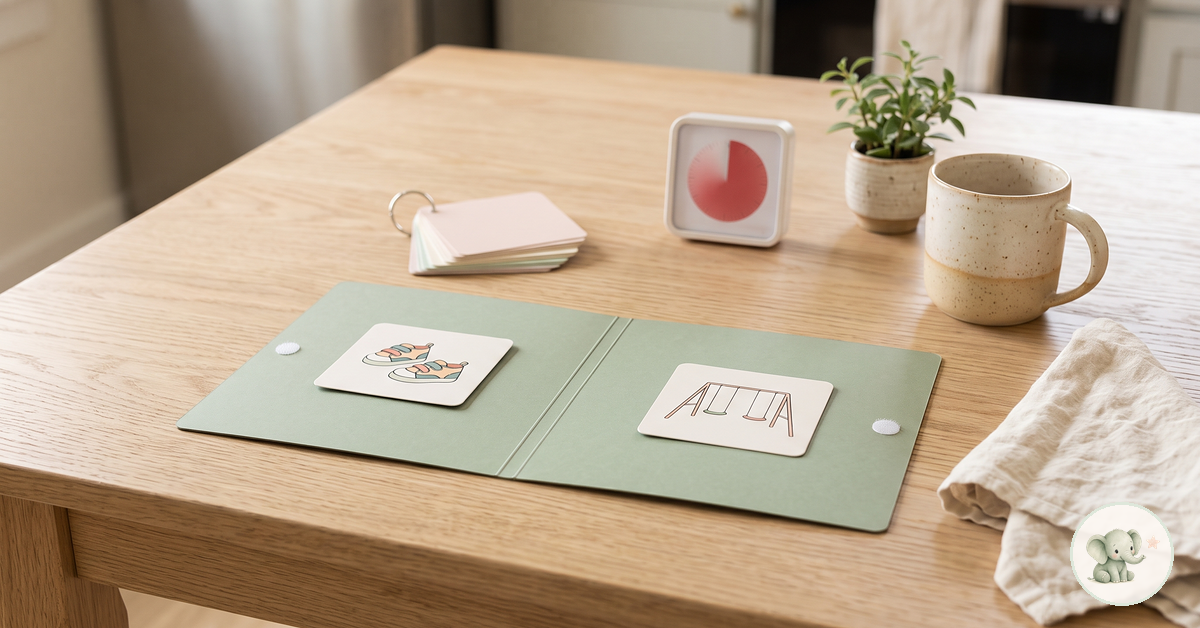
Two squares. A picture on the left, a picture on the right. That’s it. A first then board doesn’t look like much, and for a long time I didn’t think it would do much either. Now it’s the thing I reach for when a day starts to wobble, when we’re leaving the house, and (especially) when the holidays turn our whole routine upside down.
Here’s what a first then board is, how we actually use ours with Christopher, the mistakes I made at the start, and how to make one at home tonight with stuff you probably already have.
What Is a First Then Board?
A first then board is a simple visual that shows two things in order: what happens first, and what comes then. Usually the “first” is the less-fun thing, and the “then” is something your child wants.
First shoes, then a song in the car.
First teeth, then story.
First two more bites, then all done.
It sounds almost too simple. But for a lot of autistic kids (and honestly, a lot of kids, period), hearing a string of words is hard and seeing a picture is easy. The board takes the deal out of my mouth and puts it where he can see it. There’s nothing to argue with. The card says what it says.
Teachers, BCBAs and SLPs use first then boards all the time, at school and in therapy. You’ll also hear it called a first/then chart, a first then visual schedule or, if you’re in the UK, a “now and next” board. Same idea.
Why It Works for Us
Christopher is 7 now. Like a lot of autistic kids, he likes to know what’s coming, and he really doesn’t love surprises. When I used to say “Put your shoes on, we have to go,” what he heard was the end of something he liked and a big blank of who-knows-what.
The first then board fills in the blank. He can see that shoes aren’t the end of the story. There’s something good right after.
A few other reasons I think it works:
- It’s short. One step and one reward. He doesn’t have to hold a whole morning in his head.
- It’s the same every time. The same board, the same words, the same pictures. Predictable is calming.
- It’s a promise I can keep. The “then” happens right away, every time. (More on that below, because this is where I messed up.)
- It lowers my voice. I point instead of nagging. That alone changes the temperature in the room.
How We Use Our First Then Board at Home
Here are the real first thens that live on ours. Yours will look different, and that’s the point.
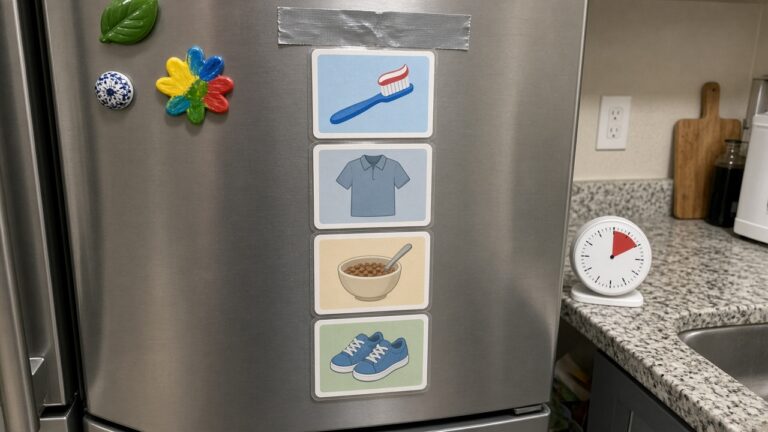
Getting out the door. First shoes, then a favorite song in the car. This is the one we use most. The song is his pick, and it starts the second the seatbelt clicks.
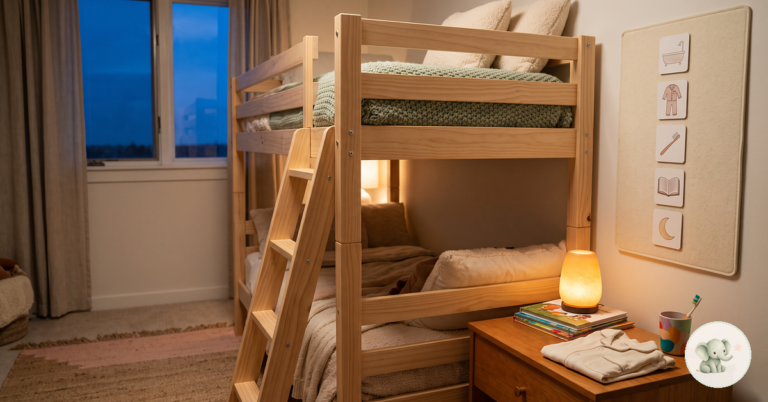
Brushing teeth. First teeth, then story. Teeth is still the card he fights me on. What kid doesn’t? But when he can see Story Time sitting right there, he gets to the sink a lot faster than when I ask for the fourth time. (It’s part of our whole bedtime routine for an autistic child, if you want the full wind-down.)
Homeschool work. We homeschool, and some lessons are a harder sell than others. First math page, then outside. I keep the “first” small, like one page, not the whole workbook.
Transitions he doesn’t love. Turning off a show, leaving a place he likes, stopping a game. First clean up, then snack. The board gives the transition a shape.
What I’ve noticed is that the board works best for the small, everyday stuff. It’s not a fix for a meltdown that’s already happening. (In those moments I stop talking, give him space and wait. The board can come back out once he’s calm.)
How to Use a First Then Board (Step by Step)
If you’re just starting, here’s the order I’d follow. I learned most of this the hard way.
- Pick one sticky moment. Not ten. Just the one that’s hardest right now, like shoes or teeth.
- Choose a “then” your child really wants. It has to be something they care about today, not something you think they should want. Ask them, or offer two choices.
- Keep the “first” short. If the task is big, shrink it. “First two pages,” not “first homework.”
- Show it and say it in a few words. Point to each picture: “First shoes, then song.” Then stop talking. Fewer words is the whole trick.
- When the first is done, say “done!” Move the card or flip it over so they can see it’s finished.
- Give the “then” right away. Every single time. This is what makes the board trustworthy.
- Practice when things are calm. Try it with something easy and fun first (first a high five, then bubbles) so the board feels good before you need it for the hard stuff.
First Then Board Mistakes I Made (So You Don’t Have To)
I used it as a threat. Early on, I’d hold it up like a warning: “First shoes, or no song.” He could feel the difference. The board is a promise, not a punishment. If it starts to feel like a threat, it stops working.
My “then” was too far away. “First shoes, then we’ll go to the park later this afternoon” is not a then. For a young kid, later might as well be never. The then needs to come right after.
I didn’t follow through. Once or twice, the then just didn’t happen (we were late, the song didn’t load, life). Each time, the next board was a harder sell. Now if I’m not sure I can deliver the then, I pick a different one.
I had too many cards out. A first then board is two steps. When he was ready for more, we moved up to a full visual schedule for our mornings. My visual schedule for autism post walks through how we set that up.
How to Make a First Then Board at Home
You do not need anything fancy. Honestly, our very first one was a sticky note with two boxes drawn on it. But if you want one that lasts, here’s what I’d use.
The board. A piece of card stock folded in half, a file folder cut down, or the back of a clipboard. Draw a line down the middle and write FIRST on one side and THEN on the other.
The pictures. Simple drawings, clip art or real photos all work. Some kids do better with a photo of their real toothbrush or their real car. Use one picture per card and keep them the same every time.
Make it last. If you laminate, the cards survive little hands, the kitchen sink and the bottom of a diaper bag. A thermal laminator like the Scotch Thermal Laminator pays for itself fast if you make a lot of visuals. If you just want to try it first, Scotch self-seal laminating pouches work with no machine at all.
Make the cards movable. A dot of Velcro on each square and on the back of each card means you can swap the first and the then in two seconds. We use these VELCRO Brand sticky back dots.
Keep your cards together. We punch a hole in the corner of our most-used cards and keep them on a 1-inch metal binder ring. It lives in the car bag, so the board can come anywhere.
Optional: a visual timer. For a “first” that’s about time (first 10 more minutes of play, then bath), a Time Timer visual timer shows the time running out as a red disk that gets smaller. It saves me from being the bad guy when time’s up.
If you’d rather skip the drawing and cutting, I made printable versions. The free Routine Cards Starter Set on my shop page includes a First/Then board, a small morning routine board and 6 picture cards. It’s free when you join my email list. The Visual Daily Routine Cards go further, with morning and bedtime boards, a First/Then board, a 5-star token board and blank cards for the things that are special to your family.
First Then Board Examples You Can Steal
Here are first thens that work well for a lot of families. Take what fits.
- First shoes, then car song
- First teeth, then story
- First bath, then pajamas
- First clean up, then snack
- First one page, then a break
- First doctor, then park
- First haircut, then favorite treat
- First car ride, then Grandma’s house
- First “hi” to the family, then quiet room
Using a First Then Board for the Holidays
The holidays are when our first then board works overtime. Big gatherings, long car rides, new places and a lot of people who mean well but talk a lot. Here’s how we bring it along.
- For the drive. First car ride, then Grandma’s house. Add a photo of the actual house if you can.
- For saying hello. First a high five, then the quiet room. He doesn’t have to hug anyone, and he knows a break is coming.
- For the meal. First sit at the table, then all done. Keep the first small. Sitting for a few minutes is a win.
- For leaving. First coat on, then car song. Leaving a fun place can be as hard as arriving.
If your family is new to all this, my Thanksgiving with an autistic child post has the picture schedule and the little story we use for the big day. The Going Places Visual Cards are also handy for holiday outings, with picture stories for new places and cards for the car, the store and waiting.
For Teachers, BCBAs and SLPs Reading This
If you use first then boards at school or in therapy, the single most helpful thing you can send home is a photo of the board you use, plus the exact words you say. When home and school use the same pictures and the same words, it carries over so much faster. A parent can make a matching board in five minutes.
And parents, it’s okay to ask your child’s team, “Can I see the first then board you use with him?” It’s one of the easiest ways to get everybody on the same page.
Quick Answers
What is a first then board? A simple two-part visual that shows what happens first (a task) and what comes next (something your child wants). It helps kids see that a less-fun step leads to something good.
How do you use a first then board? Put a picture of the task under FIRST and a picture of the reward under THEN. Point and say it in a few words. When the first part is done, give the then right away.
What age is a first then board for? There’s no set age. They’re common with toddlers and preschoolers, and plenty of older kids and even adults use a written version. Christopher is 7 and still uses his.
What’s the difference between a first then board and a visual schedule? A first then board shows two steps. A visual schedule shows a whole routine, like the full morning. Many kids start with first then and grow into a schedule.
Is a first then board only for autism? No. It helps lots of kids who do better when they can see what’s coming, including kids with ADHD, speech delays, or just a strong dislike of transitions.
Where to Start
Grab a sticky note tonight and draw two boxes. Pick your one hardest moment, choose a then your child really wants, and try your first first then board tomorrow. Keep it short, keep your promise, and keep your words few.
When you’re ready for more, the free Routine Cards Starter Set and the printables are on the shop page and on Etsy. If you’re new here, you can read our story or head to Start Here.
Tell me in the comments: what’s on your first then board right now? I’m always looking for new ideas, and so are the other parents and teachers reading this.
With love,
Michelle